Grow · pruning
Pruning Roses by Flowering Habit and Season
Classify a rose by growth and flowering habit before pruning, then remove dead wood and make only the cuts that its framework can replace.
Published Last updated
In this guide
Classify the rose before choosing a date
Pruning time follows the wood that carries the next flowers. Roses that build bloom on new seasonal growth can tolerate their main shaping before that growth expands. Once-flowering old garden roses and ramblers often depend on established stems for the coming display; a major reduction before bloom can remove the very framework the gardener expected to flower.
That biological distinction matters more than a national calendar date. Bud movement and winter injury appear at different times across climates, and the boundary between live and killed cane becomes legible only as local growth resumes. Published months are regional examples. The plant's development and local Extension timing provide the working evidence.
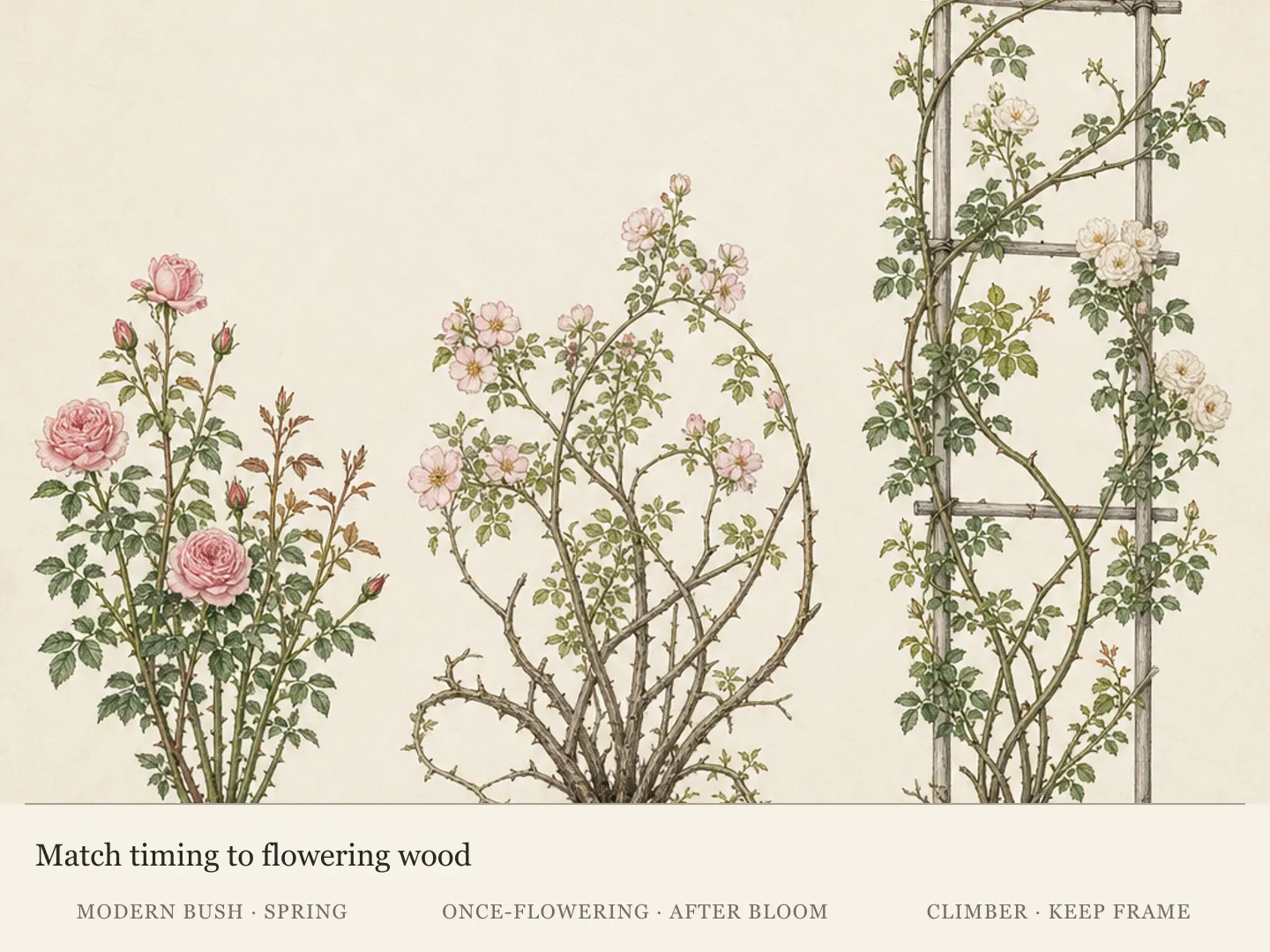
Growth habit adds a second layer. A compact bush can renew from a low framework, while a climber or rambler may depend on long principal canes that carry shorter flowering laterals. Treating every long stem as excess converts a trained rose into a bush and can erase years of useful structure. The support system is therefore part of the plant record, not scenery around it.
Uncertain identity calls for a season of observation, not confident improvisation. Certainly dead, broken or diseased tissue can be addressed while sound mature canes remain. Flower timing and the location of blooms along old or new growth then reveal which framework the plant uses. That record is stronger than assigning an unknown shrub the routine of a familiar hybrid tea.
Several pruning windows can belong to one rose because they answer different questions. Winter damage becomes visible around spring growth, repeat bloomers may be deadheaded during the season, and renewal of a once-flowering framework may wait until its display ends. A safe action in one window does not authorize every structural change at once.
Keep timing, intensity and cut type as separate decisions. The rose may be ready for removal of killed tips but not for renewal of sound main canes; a flowering lateral may need shortening while its supporting cane remains essential. Record each cane's condition and role before cutting, because that classification determines which future flowering wood must be preserved.
Let flowering habit choose the timing and retained canes
Identify whether the rose carries its next display on new seasonal growth or retained older framework. Assess dead and damaged wood separately, then apply the class-specific shaping rule. Keep a climber's principal canes tied to sound support with room to expand. A single reduction height cannot replace the flowering-habit decision for every rose.
Flowering wood determines pruning intensity
Hybrid tea, grandiflora, and floribunda roses flower on current-season growth and commonly receive the strongest early-spring reduction after winter injury is removed. Retain a small, well-spaced framework of vigorous live canes and remove surplus weak growth. The amount of living cane left by winter varies, so a fixed national cutting height can remove useful tissue in one garden and leave dead wood in another.
Read winter injury before shaping a modern bush. Begin at the tips and follow discoloration downward until cuts reveal sound tissue and living buds. Only then compare the remaining canes for spacing, vigor, and direction. Shaping before the dead boundary is known can produce a neat outline that still contains damaged cane or sacrifice the strongest living framework.
Repeat-flowering shrub and landscape roses usually need selective thinning and modest size control, not hybrid-tea treatment. Their natural arching or mounded framework supplies much of the plant's character. Remove dead and crowded stems, then decide whether any older cane needs renewal. Severe, uniform reduction can discard mature flowering wood without improving the structure.
Young shrub roses may need little structural pruning while their habit becomes clear. Preserve leaf area and sound framework during the early seasons, removing damage and obvious congestion. Once the plant has established its form, selective renewal can remove older canes over time while retaining enough mature wood to flower.
Established stems carry the principal display on old garden roses and ramblers that flower once. Before bloom, limit work to wood that is certainly dead or damaged. Make significant thinning or renewal after flowering, when the display has finished and replacement growth can develop. Pruning those roses hard in early spring trades the coming bloom for a mistaken sense of tidiness.
An established once-flowering rose with no dead, damaged, or congested wood may not need significant pruning every year. Inspect it on schedule, but let the framework and stated purpose determine whether a cut follows. Skipping unnecessary reduction preserves flowering stems and makes the eventual renewal decision easier to see when an older cane truly needs replacement.
Repeat-flowering old garden roses and climbers may use both new and older wood, so the label and flowering record still matter. Do not let the broad word old or climbing decide the cut. Preserve the permanent framework, identify which laterals carry flowering growth, and use the lightest reduction that accomplishes a stated need.
Use live tissue to set the first cut
In cold regions, wait for swelling buds to clarify the boundary between live and winter-killed cane. Dark, shriveled wood and brown or gray tissue across a fresh cut indicate damage, while healthy cane shows pale pith and green tissue beneath the bark. Follow the injury downward and reassess after each cut rather than choosing a height from the outside appearance.
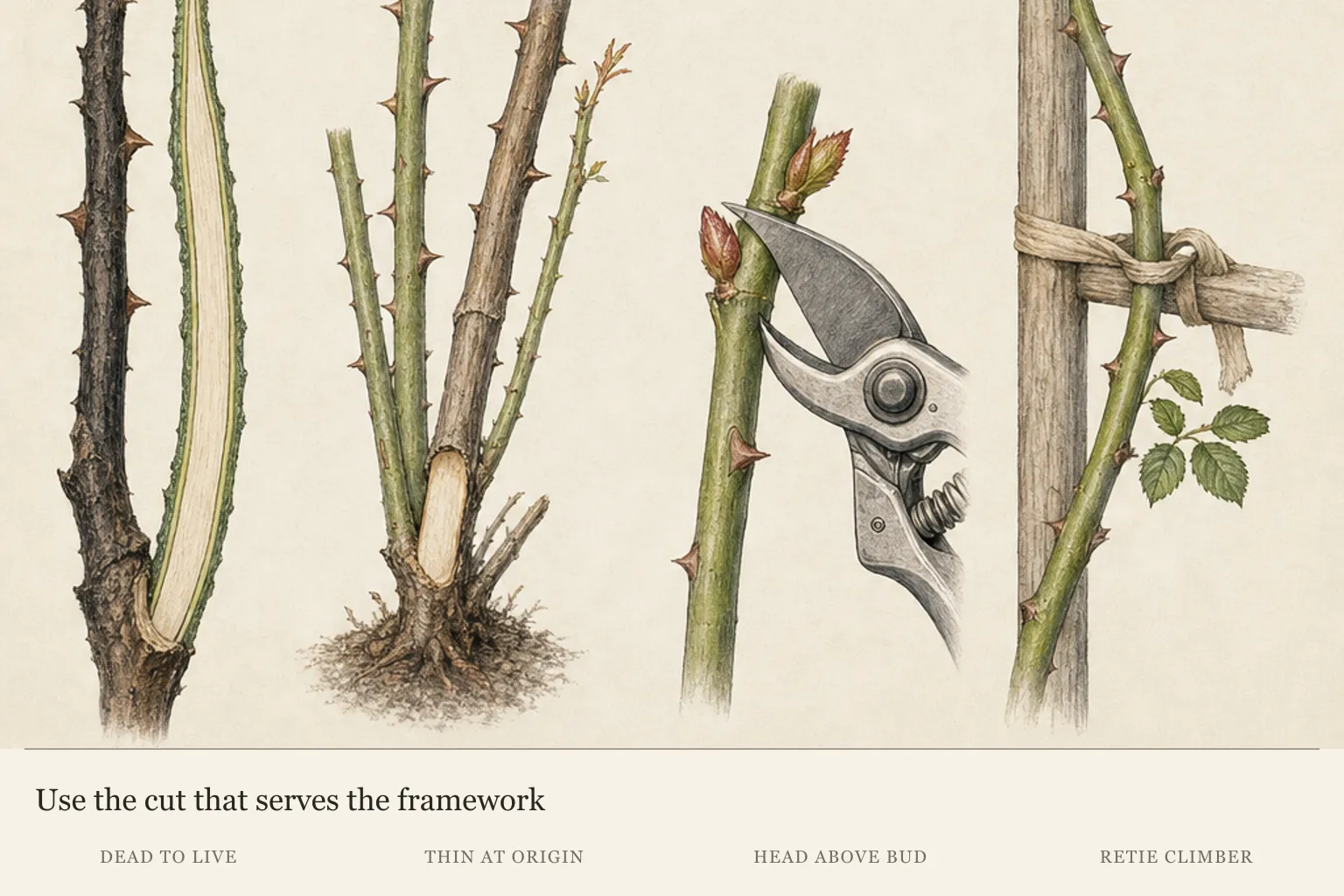
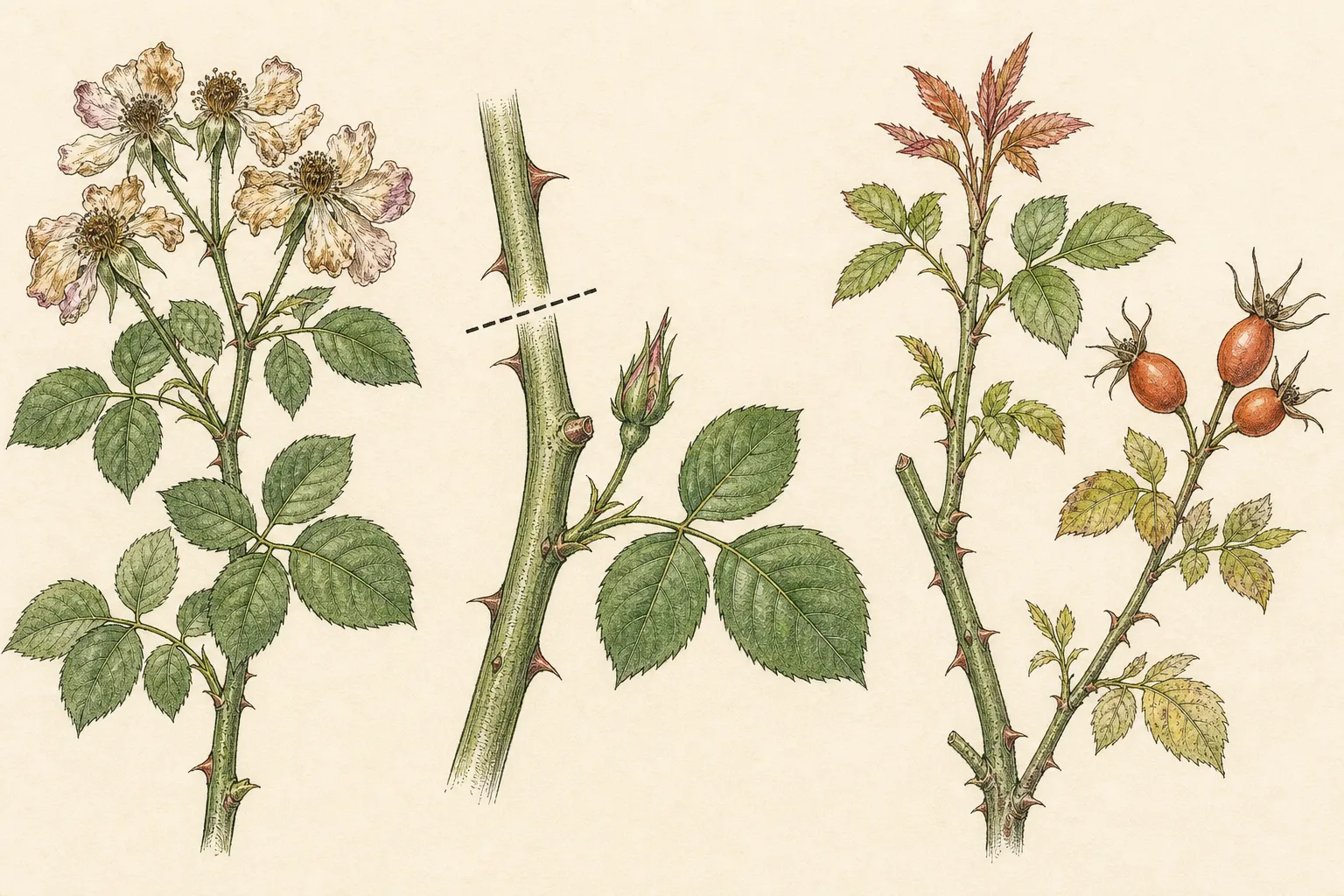
Remove an entirely dead cane at its origin. When part of the cane remains alive, recut into sound tissue above a healthy bud that can direct replacement growth. Avoid leaving a dead stub beyond the living point or cutting through the bud itself. The finished cut should preserve sound wood and have a clear structural purpose.
Use thinning cuts to remove a whole cane or branch at its origin when it is dead, weak, rubbing, or creating congestion. This opens working room without shortening every remaining stem. Select canes one by one, stepping back after each removal. Several individually reasonable thinning cuts can still strip the plant if their combined effect is not reviewed.
Use heading cuts to shorten living cane and direct growth from a selected healthy bud. An outward-facing bud often helps keep new growth from returning into the congested center. Place the cut just above the bud without leaving a long stub. The direction and vigor of the retained cane matter more than creating identical heights across an irregular framework.
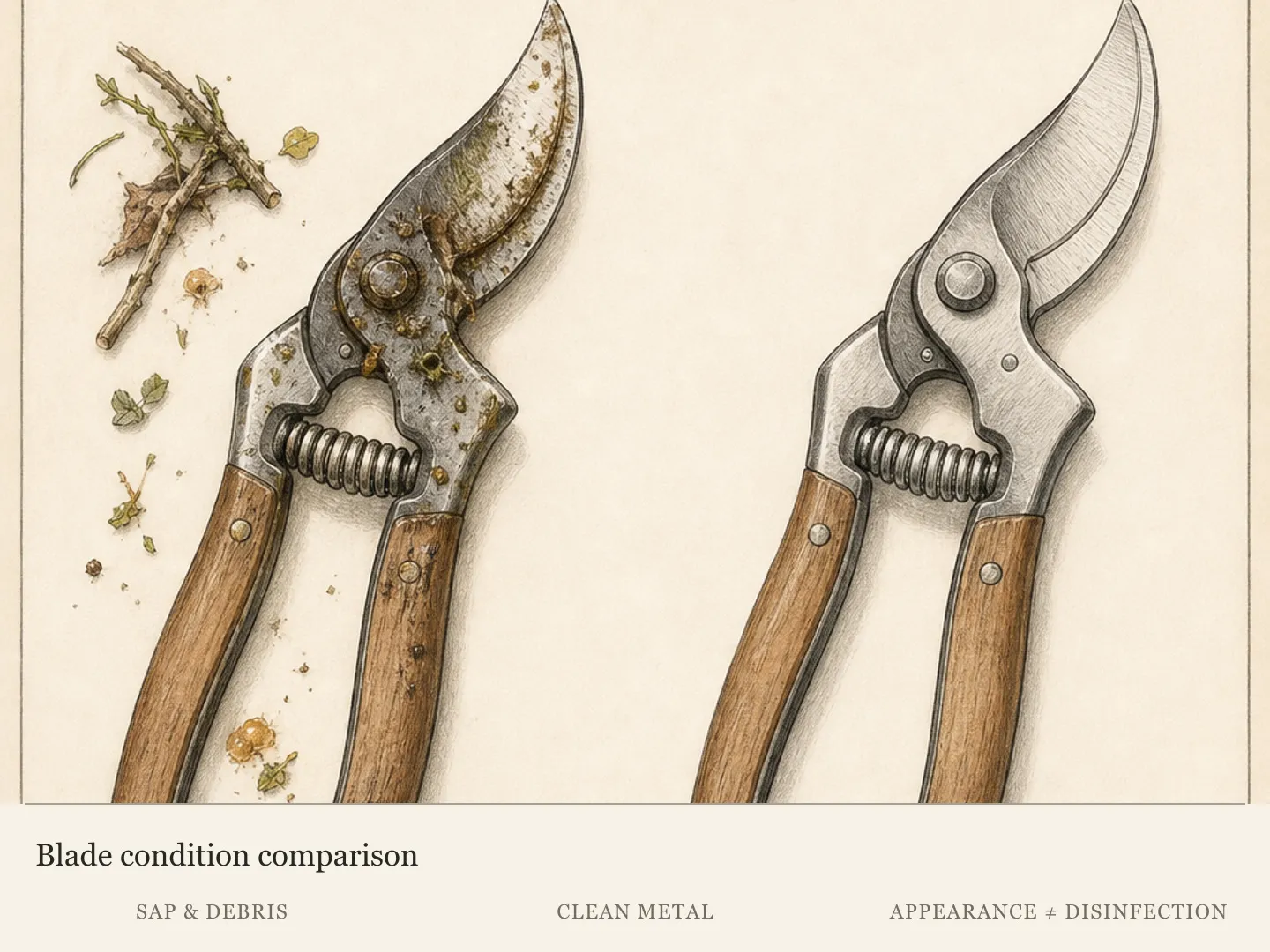
Keep clean sharp bypass pruners for canes within their capacity and change to loppers or a pruning saw for larger wood. A dull or undersized tool can crush cane and pull the cut away from the intended point. Match the tool before applying force, keep the plant supported, and recut a ragged surface only when enough sound tissue remains.
Review light and air after the deadwood and congestion passes, but preserve the rose's natural habit and useful leaf area. An open center is a functional aim, not a demand to remove every inward-growing stem. Stop when the retained framework is sound, separated enough to work among, and proportionate to the rose class.
A climber is a permanent framework
Climbing roses do not attach themselves. Their principal canes need a sound support and loose ties that hold without constricting growth. Inspect the trellis, fence, wall fixings, and existing ties before pruning. A cane retained as permanent framework is useful only when its support can carry it safely and leave room for later adjustment.
Trace each principal cane from the base before cutting laterals. The main canes establish the long-lived structure; side shoots carry many of the routine heading cuts. Mark the principal stems temporarily so a crowded crossing does not lead to accidental removal of the framework while attention is focused on smaller growth.
Confirm whether the climber flowers once or repeats. Once-flowering ramblers are pruned after bloom, while repeat-flowering climbers commonly receive their main work in early spring. The broad climbing habit does not settle timing. Removing an old main cane without that distinction can remove both structural reach and the stems expected to carry the next display.
Train suitable long canes toward horizontal where the support and cultivar allow it. This orientation can encourage flowering laterals along more of their length. Bend and tie gradually, respecting the cane's flexibility; a forced angle that cracks the stem does not improve the framework. Use soft ties and leave room for expansion.
After winter damage is removed, shorten selected laterals and redirect wayward new growth without reducing every main cane. Keep access between the rose and support for retieing and future pruning. Where principal canes cross or rub, decide which one better serves the framework and remove the conflict at an appropriate origin.
Step back before removing an old main cane. Check whether a younger replacement already reaches the required part of the support and whether the rose class and season permit renewal. If the replacement is absent or identity is uncertain, retain the sound framework and observe another flowering cycle.
Separate summer deadheading from structural pruning
Deadheading repeat-flowering roses can improve appearance and encourage another flush, but it is a summer grooming decision rather than a substitute for structural pruning. Remove a spent flower in relation to the vigor and leaf area of the shoot. A young or weak rose should not lose the same amount of stem and foliage as a vigorous established plant.
Keep spent flowers on roses grown for ornamental hips. Many old garden and species roses that bloom once may need little or no deadheading for the same reason. Decide whether the seasonal display includes fruit before cutting faded blooms; the desired hip cannot be restored after the flower stem is removed.
Use regional guidance for the final deadheading date so late stimulation does not work against winter preparation. A date from another climate should not override local recommendations. Structural fall pruning is also avoided in cold-winter guidance because new growth and exposed cane can face additional injury.
After structural work, retie retained climbing canes, remove cut debris, and check every tool cut from the service side. Confirm that no severed cane remains caught in the support or under another branch. Long thorny stems should be cut into controlled sections for removal rather than pulled through the framework.
Watch where strong replacement shoots emerge during the growing season. Their position reveals whether the framework remains balanced and whether a younger cane may eventually replace an older one. Record that possibility for the next appropriate pruning window. Do not remove another mature cane immediately merely because a new shoot has appeared.
Inspect the retained framework after wind and new growth have tested it. A loosened climbing tie, a cane that settles back into rubbing contact, or a dead tip missed before leaf-out may need a limited correction. Revisit the exact problem with the correct tool and preserve the rest of the work. The checkpoint tests whether the pruning purpose was achieved without reopening the entire structure for another round of cuts.
Review the rose after it leafs out and again after flowering. Look for a missed dead tip, rubbing growth, a tie beginning to constrict, or a section that no longer fits the support. Make the smallest timely correction. The observation closes the pruning cycle without turning every new stem or faded bloom into another reason for structural cutting.
Steps
- Level
- moderate
- Time
- One pruning session; duration varies with rose class, size and winter damage
- Tools
- clean sharp bypass pruners, loppers for canes beyond pruner capacity, pruning saw for older large canes, thorn-resistant gloves and eye protection, soft plant ties for climbers
- Materials
- container or tarp for removed canes
- 1Identify flowering and growth habit
Use the plant label, nursery record, or cultivar information to confirm whether the rose flowers once or repeats and whether it is a modern bush, shrub, climber, or rambler. Record the result and choose the pruning window from flowering habit, local conditions, and bud development. If identity remains uncertain, restrict this session to clearly dead, damaged, or diseased wood.
- 2Inspect the base and support
Trace every principal cane to its origin before entering the canopy with tools. On climbers, inspect the trellis or fence, fixings, and soft ties; repair an unsafe support before relying on it. Mark main framework canes and identify a stable working route. On bush and shrub roses, note congestion, rubbing stems, winter injury, and any young replacement cane worth preserving.
- 3Remove dead and diseased wood
Start at visibly damaged tips and cut downward in small decisions until the cross-section shows pale pith and green living tissue beneath the bark. Recut just above a healthy bud when sound cane remains. Remove the entire cane cleanly at its origin when no living section survives. Clear each dead piece before it becomes entangled with the canes still under review.
- 4Take out weak and rubbing growth
Use thinning cuts at the point of origin for weak stems and canes that cross, rub, or close the working space. Compare the two stems before choosing which one to retain, favoring sound growth that supports the natural framework. Step back after every major removal and stop before a sequence of sensible cuts becomes an unnecessarily stripped plant.
- 5Apply the class-specific reduction
Reduce modern bush roses more strongly only after winter damage is removed, retaining a small well-spaced set of vigorous canes. Thin repeat-flowering shrubs selectively and preserve their natural mature framework. On once-flowering old garden roses and ramblers, postpone major renewal until after bloom. Keep young shrubs lightly pruned while their form is still developing.
- 6Direct live shoots with heading cuts
Shorten a selected living cane just above a healthy outward-facing bud, placing the cut so it directs new growth away from congestion. Avoid a long dead stub and avoid cutting into the bud. On climbers, apply these heading decisions chiefly to selected laterals and wayward growth while retaining principal canes that belong to the permanent support framework.
- 7Retie and review the framework
Arrange retained climbing canes on the sound support and secure them with soft ties that leave room for expansion. Clear all cut debris in controlled sections. Walk around the rose and check that light, air, and working access improved without erasing the class-appropriate framework. Record replacement shoots or old canes to reconsider at the next proper pruning window. After leaf-out and flowering, recheck for a missed dead tip, renewed rubbing, a constricting tie, or a replacement shoot that changes the future renewal plan. Add each finding to the rose's class and flowering record before the next session.
Related reading
Sources
- Pruning Roses. University of Illinois Extension. Source record · Accessed 2026-08-16.
- How to Prune Roses. Iowa State University Extension and Outreach. Source record · Accessed 2026-08-16.
- When Should I Prune Shrub Roses?. Iowa State University Extension and Outreach. Source record · Accessed 2026-08-16.