Gardens · dry herb border
A Dry Herb Border with Lavender and Rosemary
Design a dry herb border as one sunny, free-draining hydrozone, using lavender repetitions, rosemary anchors, mature footprints, and an accessible edge.
Published Last updated
In this guide
- Prove the site before choosing plants
- Lay out a 14-foot border for a Zone 6 Pennsylvania garden
- Draw a hydrozone with an establishment layer
- Place the rosemary at full size first
- Use lavender to set the rhythm
- Keep every crown within reach
- Resolve winter before fixing the composition
- Let the surface reveal water movement
- Design ideas
Prove the site before choosing plants
A dry herb border begins with one suitable root zone, not a list of Mediterranean plants. Place lavender and rosemary only where full sun, free drainage, regional hardiness, and their mature footprints agree. The design can then repeat lower lavender mounds, use selected rosemary forms as anchors, and preserve a clear working edge. If those conditions do not coincide, change the location or the composition before buying plants.
Watch the proposed strip through a clear day and draw the periods of direct sun. Include shade from buildings, fences, and established plants, because a sunny garden does not make every edge equally exposed. Compare this map with the exact plant labels and local guidance. A border that offers only scattered bright pockets may support a different design, but it does not become a continuous full-sun hydrozone by visual intention.
Revisit the strip during rain or irrigation. Mark where water enters, crosses, ponds, and leaves, along with lawn sprinkler reach and runoff from nearby hard surfaces. Follow the water across the entire proposed bed. One low section can undermine a continuous dry-zone plan even when the rest of the surface looks suitable.
Distinguish surface appearance from root-zone behavior. Pale gravel, a warm wall, or a crisp edge can make a site look dry while water still collects in the soil below. Persistent wetness is especially consequential for lavender, and rosemary also performs poorly in wet clay. Treat unresolved ponding or repeated overspray as a site rejection, not as a styling problem.
Drainage correction, raised-site construction, and irrigation-system alteration are separate projects beyond this border plan. Complete and observe any such work before returning to the plant layout. A dry-border drawing should describe the site that actually exists after correction, including how water now enters and leaves. It should never assume that future gravel or drought-tolerant labels will repair an unverified root zone.
Lay out a 14-foot border for a Zone 6 Pennsylvania garden
This example assumes a level 14-by-4-foot bed in a full-sun Pennsylvania USDA Zone 6 garden, freely draining soil, and a separate service path along the full front edge. It is a design calculation, not a planted trial. Use four Lavandula angustifolia plants with a documented mature spread no greater than 3 feet. NC State describes that species at 2–3 feet wide; reject a larger selection that would exceed these circles.
Mark the lavender centers 1.75, 5.25, 8.75, and 12.25 feet from the left end, all 2 feet from the front edge. At a 3-foot mature diameter, each end retains 0.25 foot and adjacent mounds retain 0.5 foot of open space. Four plants at 3.5-foot centers therefore fit the 14-foot length. The 4-foot depth leaves 0.5 foot beyond the mature foliage on both sides, while each crown remains 2 feet from the service path. Keep those gaps open for observation; this is a separated-mound composition, not an instant hedge.
Place one potted Salvia rosmarinus on separate hardstanding beside the right end, outside both the bed and the through-route. Reserve a footprint from the exact plant label and keep the pot accessible on all sides. Rosemary is not a permanent in-ground anchor in this Zone 6 example: bring the container to a suitable bright overwintering space before damaging cold, or omit it if no such space is available. Count the scheme as four permanent lavender plants plus one removable rosemary, with separate watering for the pot.
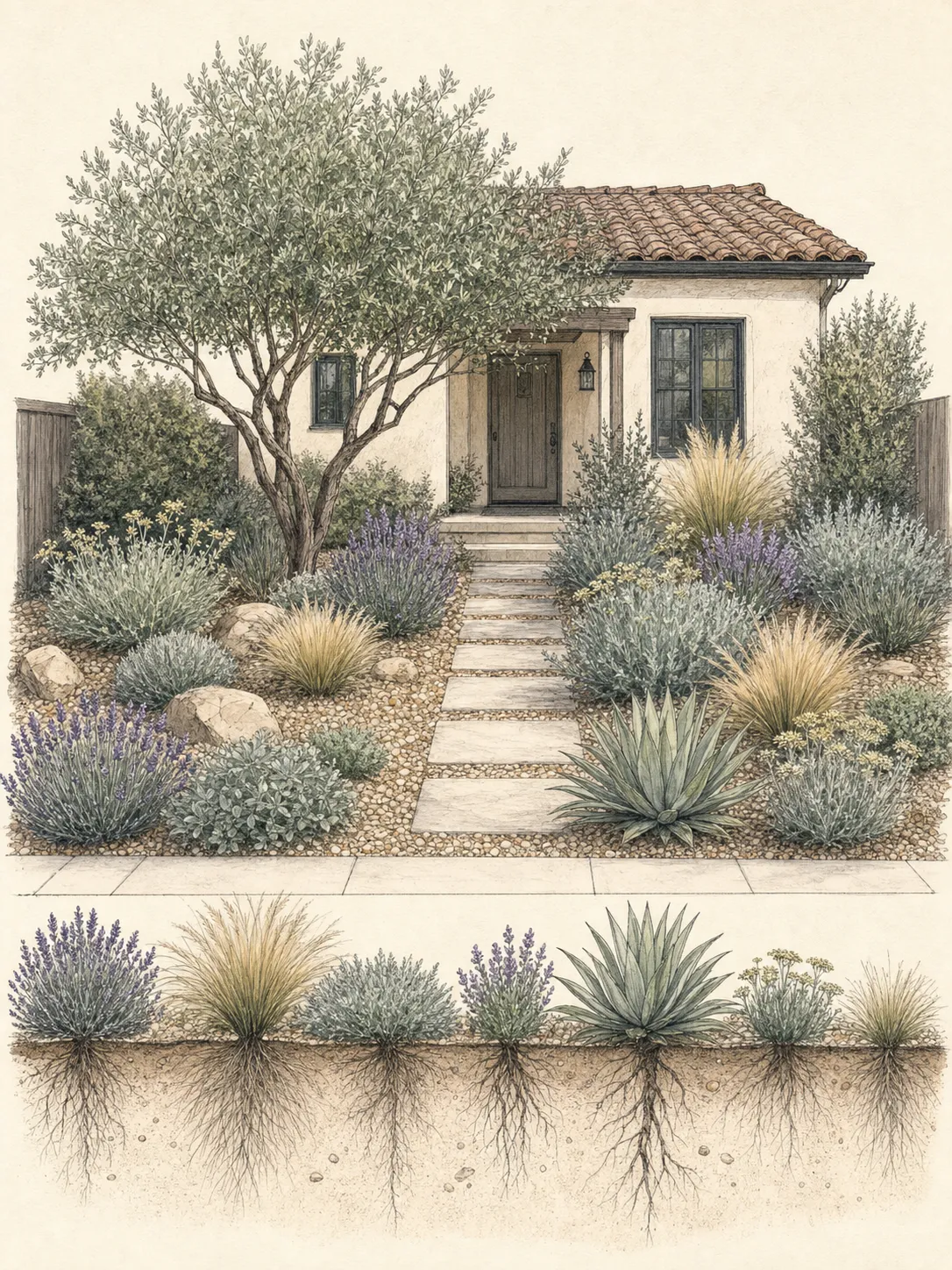
In winter, remove the rosemary pot and leave its hardstanding clear; the four lavender positions and their drainage remain unchanged. In a climate where the exact rosemary selection can stay outdoors, redesign for its full documented spread before considering the vacant pot position. The existing illustrations show the design principles schematically; the measurements here define this particular example, and do not turn those illustrations into scale drawings.
Draw a hydrozone with an establishment layer
Outline the soil volume that can receive the same mature-season irrigation decision. Keep thirstier perennials, vegetables, and turf outside that line or on independent delivery. A narrow visual edge is not enough when sprinkler reach or connected soil keeps the zones functionally joined. Hydrozoning succeeds only when water can be withheld from the established dry group without withholding it from a neighboring plant that still needs it.
Label every existing plant whose roots or irrigation share the proposed area. Compare its verified needs with the lavender and rosemary zone. An attractive survivor from the former border does not earn automatic inclusion; nor does a culinary use establish compatibility. Move the hydrozone line, relocate the mismatched plant, or redesign the bed so each group can be managed according to its own conditions.
Add a temporary establishment layer over the mature plan. Newly planted lavender needs regular water during its first year, despite its later drought tolerance, and each transplant requires observation while roots enter the surrounding soil. Show a direct watering and inspection point at every young root ball. The layer records a temporary exception without converting the entire bed to a permanently wetter routine.
Keep establishment access separate from a fixed calendar. Irrigation decisions should follow plant need, soil moisture, and local conditions, so the plan supplies observation points rather than universal intervals. Mark where the soil can be checked without disturbing a crown and where water can reach one young plant without routinely soaking the whole mature zone.
Retire an establishment notation only when local guidance and plant response support the transition. If one position continues to require different treatment, investigate the site and the plant rather than erasing the exception for visual neatness. The final hydrozone may need a revised boundary or a different occupant. A truthful plan can show fewer plants and a clearer watering logic.
Place the rosemary at full size first
Rosemary can be upright, spreading, or prostrate, and named selections differ greatly in eventual height and width. Copy the chosen plant's documented mature dimensions onto the plan while the nursery specimen is still small. The full outline, not the sale-pot diameter, determines whether the anchor fits and which neighboring plants will continue to receive light.
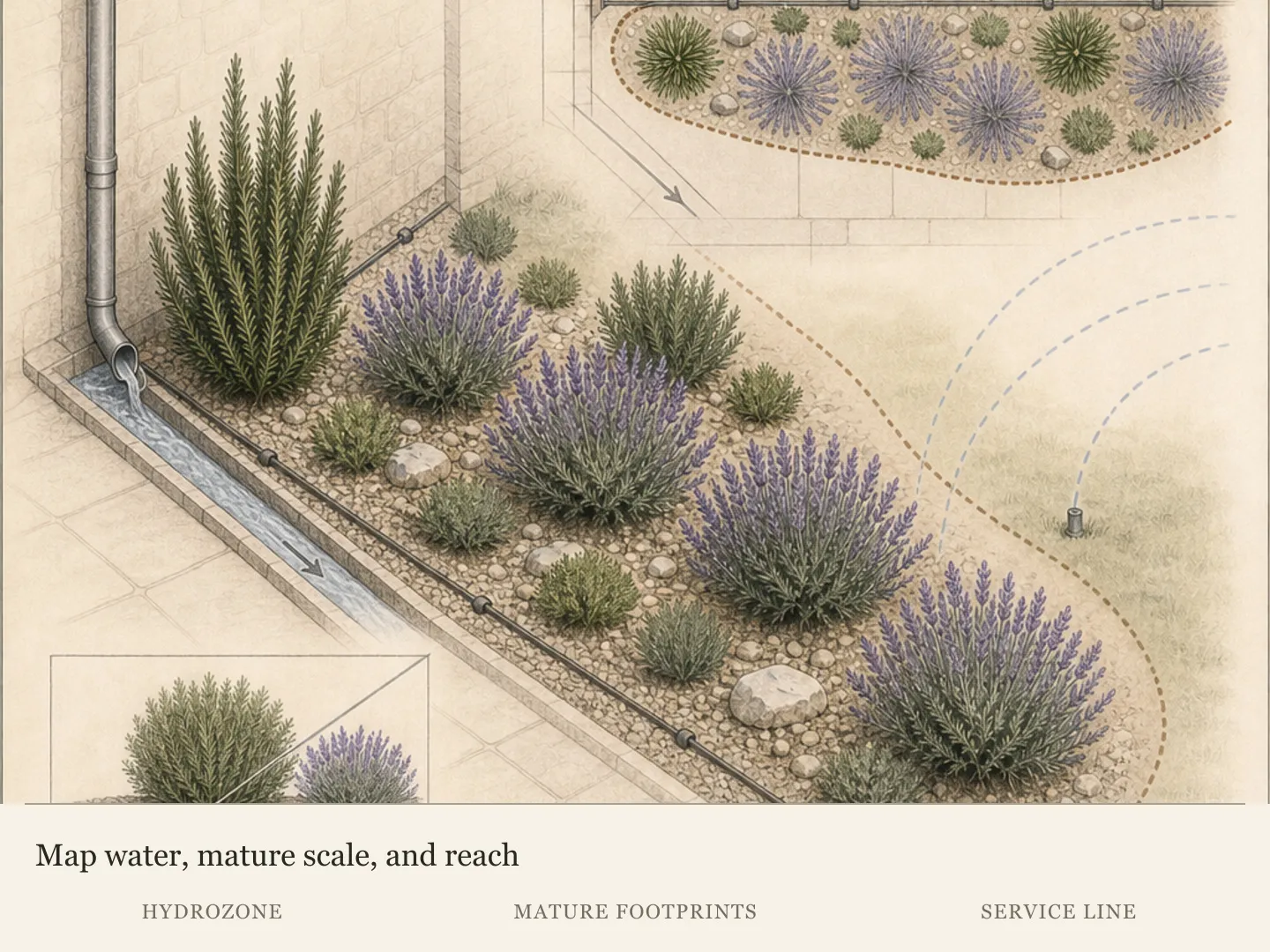
Place an upright form near an end, corner, or rear position where its mass can organize the border without narrowing the path or shading lower sun-loving plants. A spreading or prostrate form creates a different line and needs a different footprint. Choose the design role from the actual mature habit; do not stretch one rosemary symbol to stand for every selection.
Leave an inspection interval around the mature outline and keep irrigation hardware reachable from the service side. The gardener should be able to see the base, check nearby soil, and prune without standing among lavender stems. Draw that working clearance as part of the anchor. If it disappears when neighboring plants are added, the plan is already overcrowded.
Test the rosemary position against the public edge and the water map. A visually strong corner may also be the point where runoff collects, lawn irrigation enters, or a path turns tightly. Site conflict outranks visual balance. Move the anchor to a sound position, select another locally suitable form, or let lavender repetitions carry the composition without forcing a rosemary into the wrong place.
If the border cannot hold the documented footprint without repeated size control, choose a naturally smaller selection or change the composition. Pruning access still matters, but constant reduction is a poor substitute for fitting the plant at maturity. The open space around a correctly sized rosemary strengthens its silhouette and leaves room to observe how the shared root zone behaves.
Use lavender to set the rhythm
Draw each lavender at its listed mature width, then test a repeated sequence of separate mounds. Give the gaps the same attention as the plants. Open intervals preserve each outline, allow air to move, keep neighboring foliage away from crowns, and leave points where soil moisture can be observed. A row of touching nursery specimens will not mature into the same readable rhythm.
Repeat the mound at intervals that follow the border's scale and service pattern. The sequence can bend around a rosemary anchor or pause at an access point without becoming random. Repetition supplies order through foliage form and plant mass, so the composition does not depend on every lavender flowering at the same moment or matching in color.
Use mature height to protect light within the zone. Keep lower lavender where a taller rosemary will not shade it, and check the sun map with all mature outlines visible. Where the border is viewed from both sides, avoid treating one fixed front and back as automatic. Place heights to preserve exposure and access from the actual viewing and working positions.
Fill remaining positions only with plants whose verified sun, drainage, mature size, hardiness, and water demand fit the hydrozone. Mediterranean origin can suggest candidates, but it does not establish local compatibility. Give every addition a labeled footprint and a clear role, such as low edge, seasonal flower, or quiet foliage connector. Omit a plant that merely completes a shopping palette.
Edit the sequence before planting by covering each candidate footprint in turn. Removing an optional flower should leave the main lavender rhythm, rosemary anchor, water boundary, and service line intact. If the plan collapses without a crowded filler, strengthen the primary structure or preserve the opening. Negative space is part of this border's dry, inspectable character.
Keep every crown within reach
Overlay a service line along one side of the bed and measure reach from it to every crown. Widen the edge, add a stable stepping point, or reduce bed depth wherever the drawing requires leaning across rosemary or standing among lavender stems. The route must work with mature footprints, not only with newly planted gaps.
Assign recurring tasks to that line: moisture checks, establishment watering, pruning, label reading, irrigation inspection, and cleanup. Trace a hand path from the service edge to each plant base. If one crown can be reached only after pushing through another plant, revise the footprints before planting. Keeping feet out of the shared soil also preserves the root zone from repeated working traffic.
Face the calmest foliage line toward the public edge and place labels, emitters, and removable supports on the service side. This separates visual order from maintenance hardware without hiding the information needed to care for the bed. A label should remain readable after the plant reaches full width; an emitter should remain visible enough to reveal whether it is wetting the intended zone.
Use a visible edge where lawn irrigation or a neighboring bed meets the hydrozone. The line can help reveal stray water and clarify which side belongs to the dry group. Keep it permeable wherever drainage requires it, and never let an edging choice create a new place for water to collect. Its primary job is to preserve the boundary in daily care.
Walk the service route after a hard rain and during irrigation. Look for wet pockets around stepping points, splash against crowns, and runoff diverted by edging. The route is part of the water map, so a material or grade that changes flow must be redrawn. Access has succeeded only when it makes observation easier without compromising drainage.
Resolve winter before fixing the composition
Check the exact lavender and rosemary selections against local winter conditions before fixing a permanent pattern. Rosemary is a tender perennial in much of the United States, while lavender survival depends strongly on selection and winter drainage. Their shared Mediterranean association does not give them identical hardiness or make a national planting plan reliable.
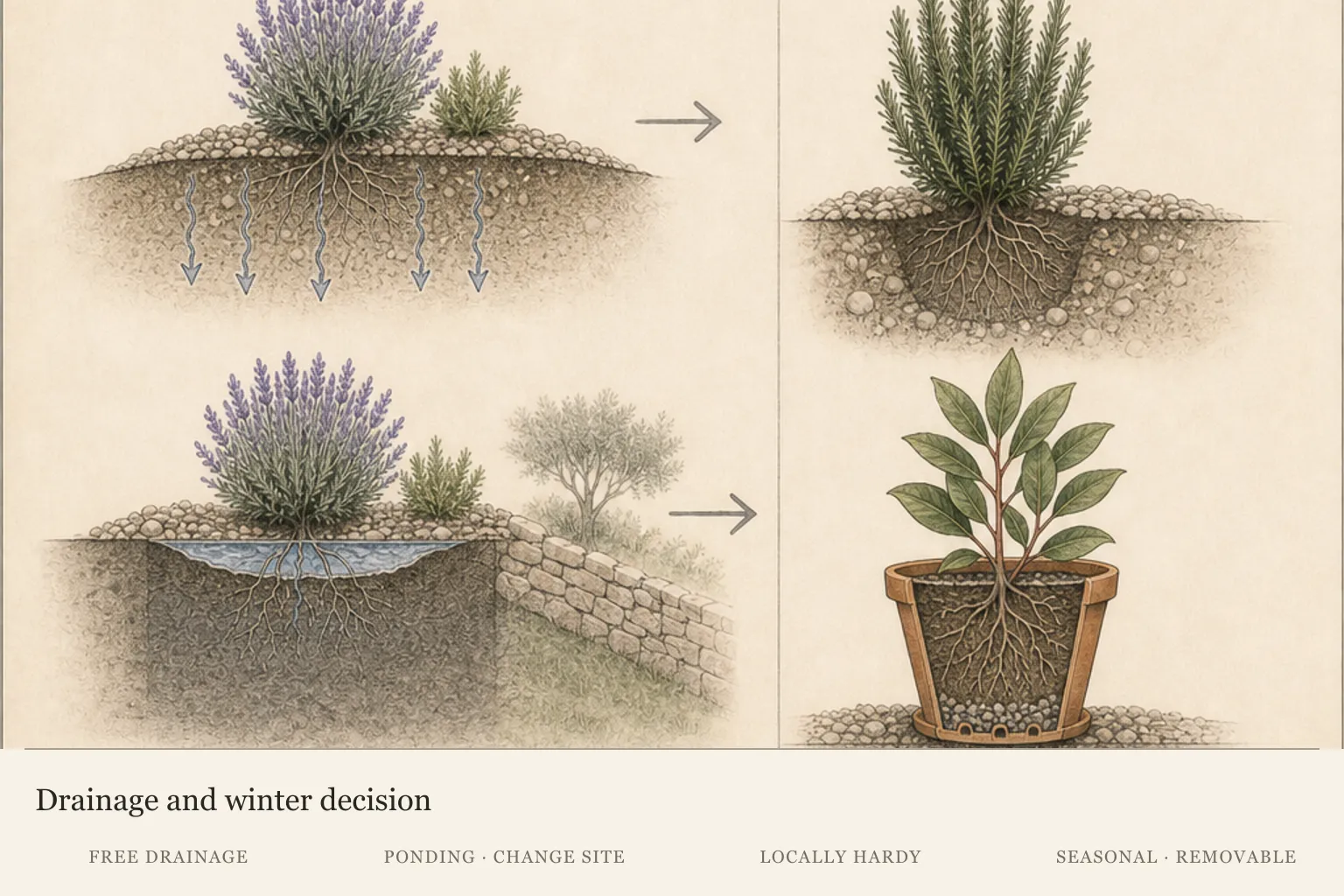
Mark each plant as permanent, seasonal, or still unresolved. An unresolved label pauses purchase; it does not become permission to assume the more favorable outcome. Confirm the cultivar and local guidance, then revise the plan. This small record prevents the visual desire for an evergreen anchor from overstating what the site can keep outdoors.
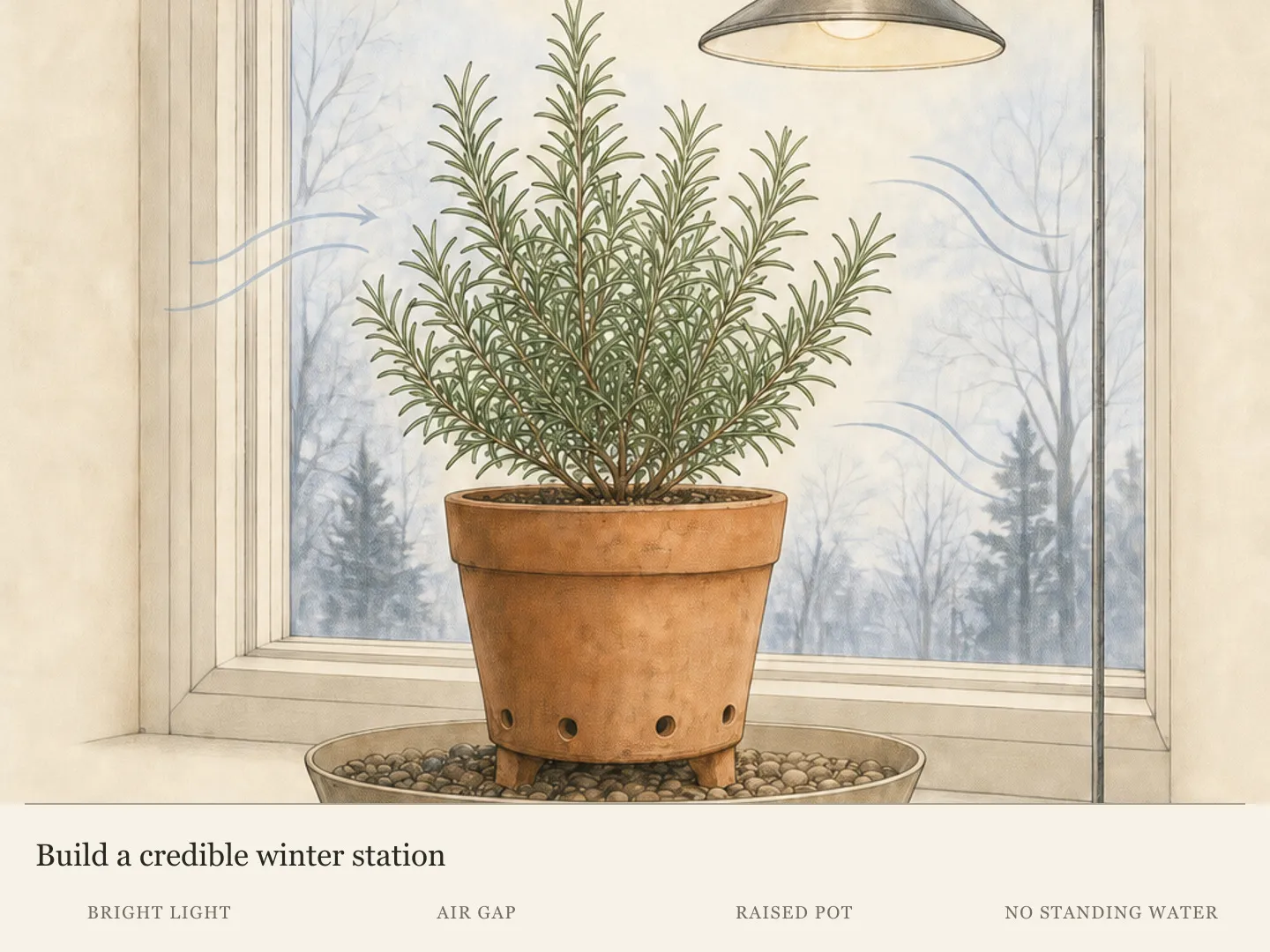
Where rosemary is not reliably hardy, draw its anchor position as seasonal. A draining container can occupy a measured hardstanding within the composition and move when regional conditions require it. The container remains a separate root zone, so keep its watering and drainage accessible and do not treat it as part of the connected in-ground irrigation area.
Design the winter vacancy deliberately. Repeat the anchor container's material elsewhere, continue a lavender or mineral line past the opening, or allow a locally suitable permanent form to hold the silhouette. The opening should remain legible when the rosemary leaves. Filling it with an unverified substitute would recreate the hardiness problem under another name.
Recheck the permanent lavender positions against the wet-season water map. A place that drains in summer may reveal different behavior during winter weather, and persistent wetness can shorten lavender life. Keep the drainage question visible in the design record. Winter planning is complete when the bed's permanent and removable parts match both local hardiness and observed moisture.
Let the surface reveal water movement
A restrained mineral surface can reinforce the border's dry character and may suit lavender and rosemary guidance, but it cannot repair saturated subsoil. Select it only after the root zone has passed the water-map test. The material belongs to the visible and maintenance layers of the design; it is not evidence that drainage underneath has been solved.
Test the proposed surface in the local setting because pale gravel reflects light and dark stone stores heat. Observe it beside the wall, path, and plant positions before covering the whole bed. Keep all mulch clear of living crowns and stems, and retain small inspection windows where soil moisture can be checked without disturbing the planting.
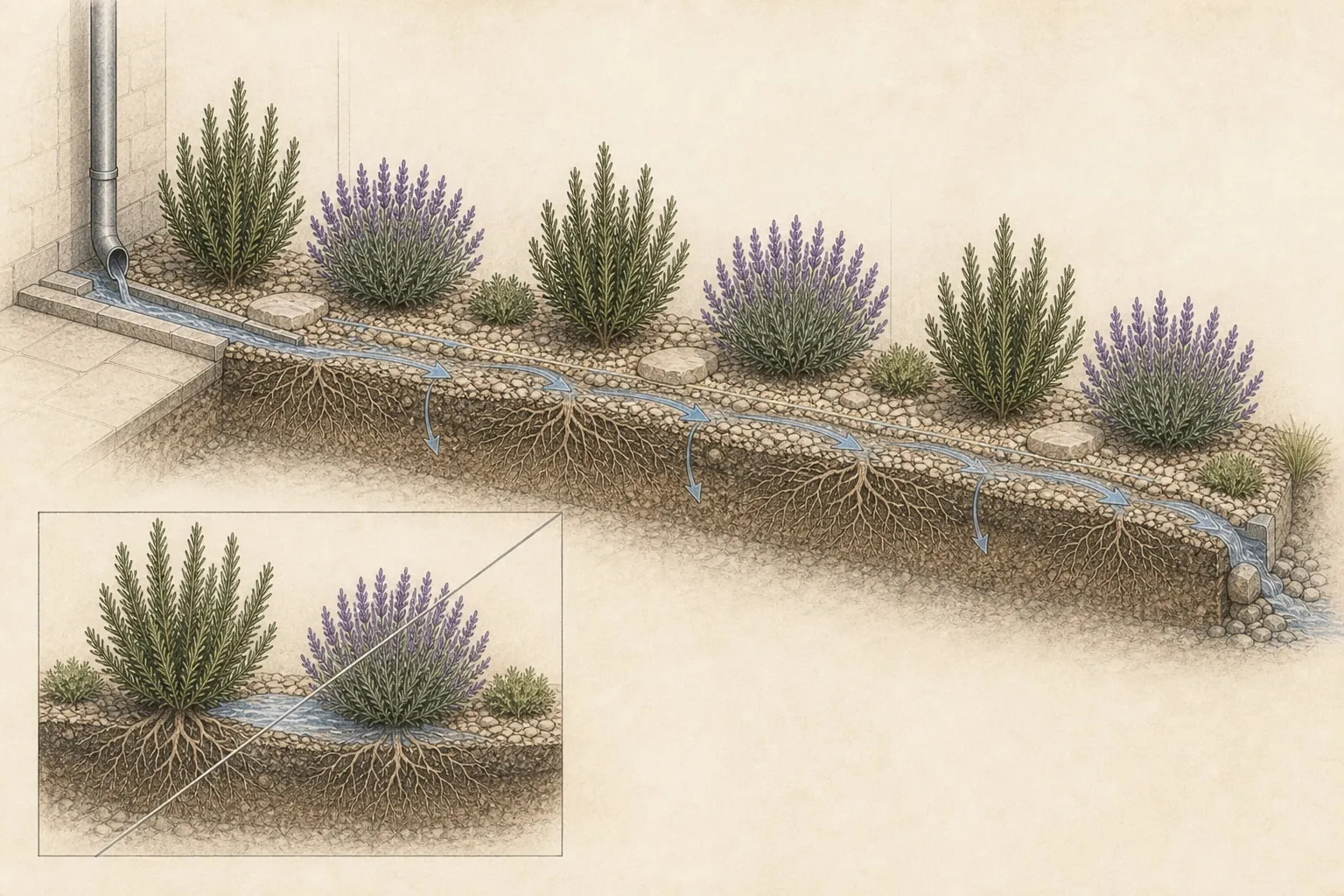
Use the surface to make water movement readable. Splash marks, displaced particles, a dark wet pocket, or a line of runoff can show where the original map was incomplete. Keep those signals visible long enough to diagnose the zone. Raking them away for appearance before recording the pattern removes information the design needs.
After the first hard rain and several irrigation cycles, redraw the water map. Note ponding, overspray, unexpectedly wet areas, and plants whose root zones behave differently from nearby positions. Correct the boundary or move a mismatched plant while the composition is young. Adding more dry-site plants to a questionable pocket only makes the conflict harder to resolve.
Inspect the border again after the first flowers fade and through the wet season. The mature planting should still make clear how the border is watered, reached and renewed. Preserve the lavender rhythm and rosemary role only where observation confirms the underlying conditions. A successful dry herb border is a coherent hydrozone whose visual order keeps its crowns, water and service decisions in view.
Design ideas
- Style
- Restrained Mediterranean dry border with repeated silver mounds and evergreen anchors
- Space
- Sunny in-ground border with independently managed irrigation and free drainage
- Climate
- Outdoor US site where each selected lavender and rosemary is verified for local sun, drainage, establishment needs, and winter hardiness
- 1Bookend the border with upright rosemary
Place one locally suitable upright rosemary footprint at each end only when both documented mature widths fit the sun and water map. Repeat separate lavender mounds between them, leaving crown clearance and a continuous service line behind the sequence. Keep irrigation checks visible from that line. If either rosemary is not reliably hardy or the border cannot hold both at full size, use the one-anchor plan instead of shrinking the footprints. Recheck both ends after rain because visually matched positions may drain differently.
- 2Use one anchor and an open terminus
Set a single rosemary at the visually heavier end where its mature form and local hardiness are verified. Let separate lavender repetitions carry the middle, then decrease their visual weight toward a clear mineral or planted edge. Preserve the unplanted terminus as access and inspection space. The open end prevents false symmetry, exposes the hydrozone boundary, and gives the composition room to absorb mature growth without adding a filler plant. Keep the final lavender mound fully reachable from the open end.
- 3Separate the dry strip from lawn water
Run a visible permeable edge between the herb border and turf, then draw the full reach of routine lawn irrigation. Watch the boundary during an actual cycle and mark every point where overspray enters. Relocate the dry strip, revise the irrigation boundary as a separate project, or leave an open buffer wherever the two systems conflict. Keep the edge accessible so future stray water remains visible rather than hidden by mature foliage. Record the observation on the permanent water map.
- 4Reserve a seasonal rosemary bay
Where rosemary is not reliably winter-hardy, size one hardstanding for an independent draining container and include its mature plant outline on the active-season plan. Connect the bay visually with repeated surface material while keeping its root zone separate. Surround it with permanent lavender only where the exact lavender is locally suitable and winter drainage is sound. When the rosemary moves, let the measured bay remain as a deliberate seasonal opening with clear access to the neighboring crowns.
- 5Repeat foliage before adding flowers
Use the contrast between narrow dark rosemary leaves and separate silver lavender mounds as the persistent rhythm. Draw that foliage pattern at mature scale before adding seasonal flowers. Assign any additional herb a specific gap, role, and service position only after its verified sun, drainage, hardiness, mature footprint, and water demand fit the same hydrozone. If no candidate passes every condition, keep the open ground as part of the rhythm and retain it on the planting plan.
- 6Turn the rear edge into a work line
Keep labels, soil-moisture observation points, irrigation access, and removable supports along a narrow durable rear edge. Draw a reach line from it to every crown and add a stable step only where the bed is too deep. Leave the front visually quiet so hardware does not dictate the public face. During rain and irrigation, inspect the work line for redirected runoff; access must not create a wetter strip behind the plants. Revise its material or grade if the map changes.
Plants in this guide
Related reading
Sources
- Growing Herbs in the Garden. Penn State Extension. Source record · Accessed 2026-08-15.
- Lavender. University of Illinois Extension. Source record · Accessed 2026-08-15.
- Herb Garden Plants: Rosemary. Penn State Extension. Source record · Accessed 2026-08-15.
- Conserve Water in Landscapes. University of California Statewide IPM Program. Source record · Accessed 2026-08-15.
- Starting Your Own Herb Garden. Penn State Extension. Source record · Accessed 2026-08-15.
- Lavandula angustifolia. NC State Extension. Source record · Accessed 2026-09-09.
- Salvia rosmarinus. NC State Extension. Source record · Accessed 2026-09-09.